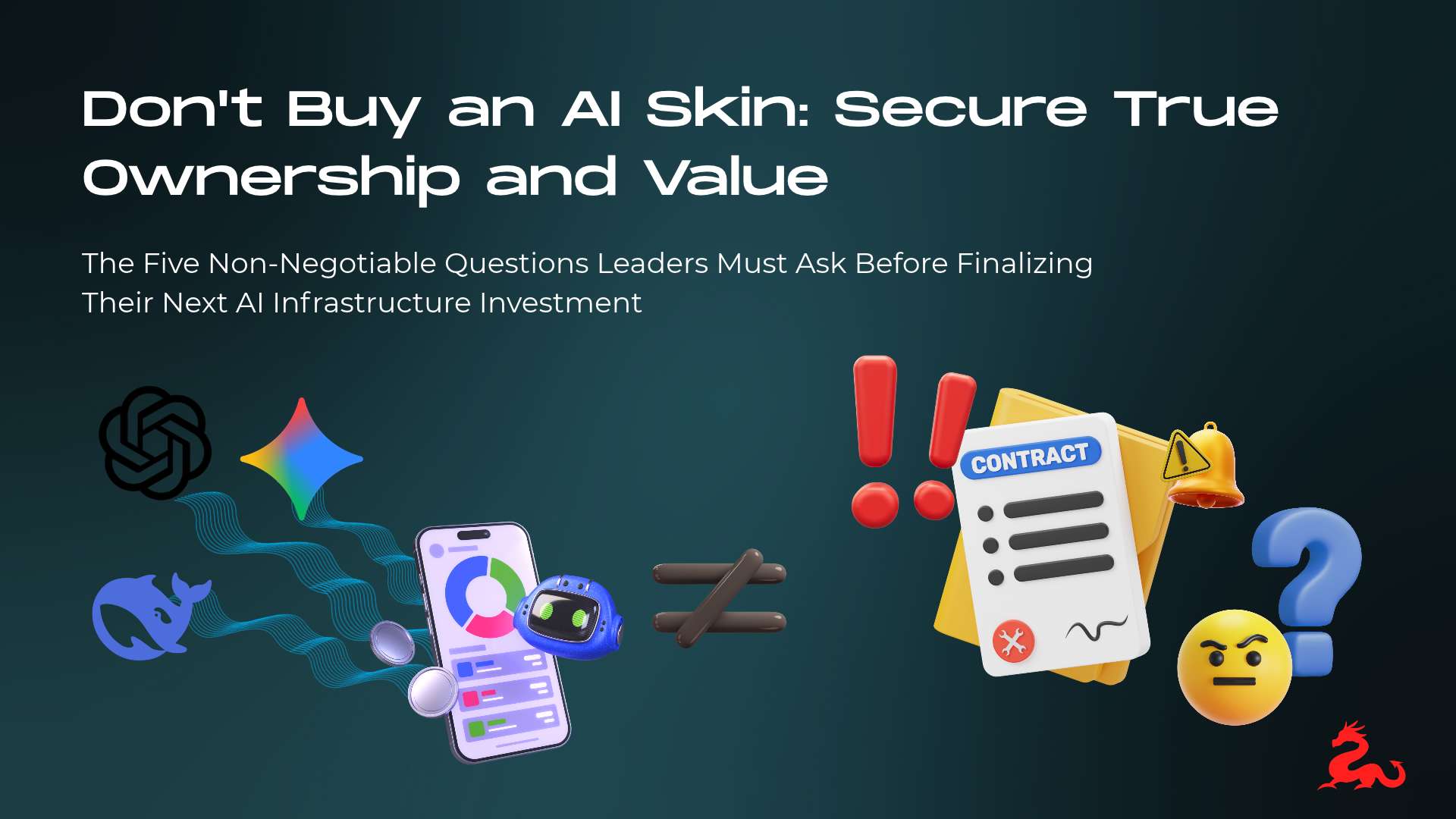
Executives, investors, and innovators are rushing to “buy AI.” Yet in most cases, what they are actually buying are skins: interfaces and agents built on top of existing models they do not own. The brutal reality is this: buying an AI agent does not give you the underlying model. Competitors who understand this distinction are already securing control, while those who hesitate are locking themselves into dependency and illusion.
The Strategic Imperative
Ownership of the underlying AI model is the difference between strategic independence and vendor dependency. Without ownership, you cannot validate, adapt, or scale with confidence. You are at the mercy of external providers, vulnerable to pricing shifts, licensing restrictions, and opaque limitations. True leaders recognise that AI is a tool, not a panacea, and that ownership, not superficial access, is what secures long-term competitiveness.
Case Studies of Decisive Action
Case Study 1: Financial Services Firm
In 2024, a global bank discovered its “AI investment” was merely an agentic skin. Within six months, they renegotiated for partial model ownership, enabling them to fine-tune fraud detection algorithms internally. False positives dropped by 31 per cent, saving millions annually and elevating their executives as pioneers in responsible AI adoption.
Case Study 2: Manufacturing Enterprise
A manufacturer initially deployed AI through a vendor-provided interface. Realising they lacked model ownership, they shifted to a reproducible open-source stack. Within nine months, defect rates fell 39 per cent, and they secured contracts by demonstrating transparency and independence. Their leadership was recognised for foresight and resilience.
Case Study 3: Healthcare Provider
A hospital network invested in AI diagnostics but discovered they had no rights to the underlying model. By securing co-ownership, they validated outputs against clinical standards. Readmission rates dropped 21 per cent in under a year, and their executives were celebrated for balancing innovation with accountability.
These are not hypotheticals. They are proof that decisive action on AI ownership creates tangible, defensible advantage.
Five Critical Questions to Establish Ownership
- Do we own the underlying AI model, or only the interface/agent? Response must confirm direct ownership rights, not just usage licences.
- Can we access, retrain, and fine-tune the model independently? Response must grant full technical access, not restricted vendor APIs.
- Do we hold intellectual property rights to model outputs and derivatives? Response must affirm IP ownership, not shared or vendor-controlled rights.
- Can we replicate the model environment without vendor dependency? Response must allow reproducibility, not lock-in to proprietary infrastructure.
- What contractual guarantees protect us if the vendor changes terms or ceases operations? Response must provide enforceable continuity rights, not vague assurances.
If the answers to these questions are evasive, you do not own the model; you are renting access.
Your 30-Day Action Plan
-
Step 1
Audit AI Contracts
Within the next week, review all AI agreements to identify ownership gaps.
-
Step 2
Negotiate Ownership Clauses
Within 30 days, secure rights to retrain, replicate, and control outputs.
-
Step 3
Validate Independence
Test whether your organisation can reproduce AI workflows without vendor reliance.
Markets are moving, competitors are acting, and first-mover advantages are evaporating. Buying AI skins is not ownership; it is dependency.