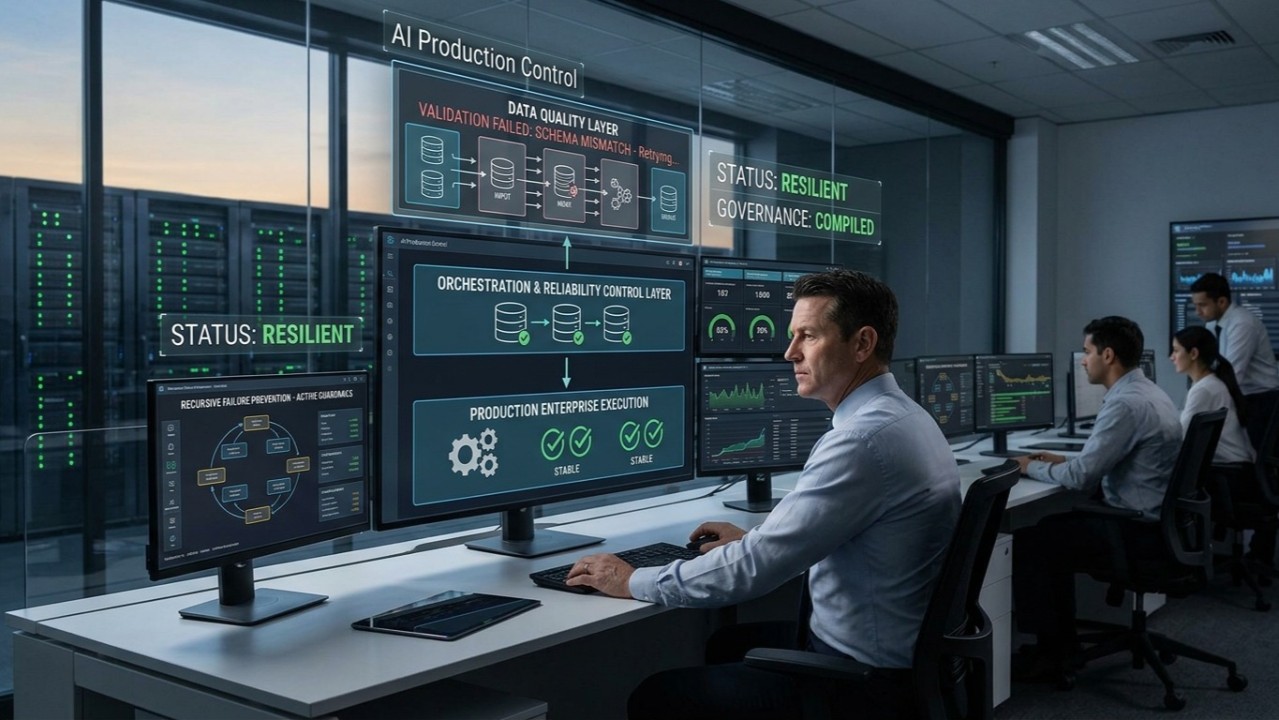
Over the last two years, almost every enterprise proved it could build a prototype. Plugging a wrapper into an OpenAI API or spinning up a single-prompt proof of concept is fast, cheap, and easy to demo in a board meeting.
Now comes the hard part: making it work reliably at enterprise scale.
Industry demand has shifted aggressively from model generation to production engineering. The bottleneck isn't finding a smarter foundational model; it's building the resilient architecture required to run AI models safely, predictably, and cost-effectively across mission-critical enterprise workflows.
Data Quality: The Foundation of Production AI
The single biggest failure point in enterprise AI isn't the model; it's the data fed into it.
In a sandbox environment, curated data sets mask underlying enterprise noise. In production:
- Dirty, Unstructured Ingestion: Disparate data silos and changing database schemas break context retrieval (RAG) fast.
- Context Drift: Models degrade when real-world production data deviates from training or evaluation baselines.
The Fix: Enterprise architecture must prioritise rigorous ETL/ELT pipelines, real-time data validation, and semantic indexing before model execution ever occurs.
Solving Recursive Failures and System Instability
When AI systems operate autonomously or handle sequential tasks, small errors compound rapidly. Left unmanaged, a slight misinterpretation in Step 1 leads to complete hallucination or system failure by Step 4.
To achieve production reliability, leaders must enforce strict architectural guardrails:
- Deterministic Validation Checks: Never rely solely on an LLM to evaluate another LLM's work without rules-based validation filters.
- Circuit Breakers & Fallbacks: When latency spikes, token limits are hit, or an output fails schema validation, systems must automatically fall back to deterministic code paths or human review queues.
- State Management: Systems need immutable execution logs and state tracking to roll back failed loops without corrupting enterprise databases.
Governance as a System Architecture Requirement
Governance can no longer be a policy document sitting in a compliance folder; it must be compiled into the system codebase itself.
- Real-Time Guardrails: Enforce strict PII masking, token filtering, and security checks at the API gateway layer.
- Observability & Auditability: Track every input, context payload, system prompt, model output, and latency metric across the enterprise application stack.
- Cost & Throughput Management: High-volume AI execution without rate-limiting and intelligent token caching will burn through infrastructure budgets within weeks.
Key Takeaways
- Shift Focus to Implementation: The most valuable skill in 2026 isn't prompting; it's software engineering applied to stochastic AI components.
- Measure System Metrics, Not Model Metrics: Evaluate latency, cost-per-transaction, schema adherence, and failure recovery rates over raw benchmarks.
- Decouple the Architecture: Design modular integration layers so underlying LLM vendors or infrastructure components can be swapped without rewriting business logic.